What proper gutter cleaning includes (and what the cheap services skip)
A man in a van with a leaf blower is not gutter cleaning. He's gutter clearing. They're different jobs.
Clearing and cleaning are not the same thing
Clearing means removing what's blocking the gutter. Leaves, moss, silt, the occasional tennis ball. It takes ten minutes a run and it makes the gutter look empty. Job done, invoice sent.
Cleaning is something else. It starts with clearing, yes. But then it continues.
Flushing the downpipes matters because debris doesn't always stay in the gutter. It travels. It compacts at the top of the downpipe, or worse, at the bottom where the pipe connects to the drain. A cleared gutter can still back up and overflow if the downpipe is partially blocked two metres below where anyone looked.
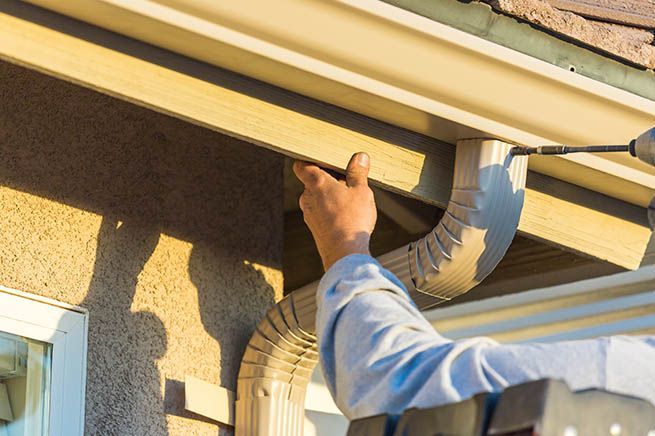
Checking the joints is part of the job too. Gutters run in sections. Those sections are held together with union brackets and sealed with rubber gaskets. Over time, those gaskets perish. The joint separates slightly. Water finds the gap and runs down the fascia board behind it, not into the downpipe. You won't see it happening from the ground.
Verifying the fall is where most cheap services don't even know what they're looking at. Gutters are not level. They're designed to slope, typically around 1 in 600, so water flows toward the downpipe rather than sitting in the channel. If the fall is wrong, water pools. If water pools, joints fail faster, moss grows faster, and the gutter overflows at a fixed point every time it rains.
Checking the brackets closes the loop. A bracket that has pulled away from the fascia, or snapped, changes the profile of the gutter. The fall shifts. The joint alignment shifts. Small problems compound.
A proper gutter cleaning service covers all of this. A clearing service covers the first five minutes of it.
What the cheap services miss
The leaflet services are not necessarily cutting corners out of laziness. Most of them are working quickly because the price they've quoted doesn't allow for anything more. At £40 or £50 for a terraced house, there's no time for anything except a quick clear and a move to the next job.
Here's what that means in practice.
Sagging brackets. A bracket pulls away from the fascia board, often because the board itself has softened with damp. The gutter dips. Water sits in the dip. The joint at that point takes more stress than it was designed for. None of this is visible unless someone is actually on a ladder looking at the fixing, not just the inside of the channel.
Separated joints. The union between two gutter sections can look fine from below and be leaking steadily behind the fascia. The water runs down the back of the board, into the rafter feet, and sometimes into the wall cavity. By the time you see a damp patch inside, the timber has often been wet for months. We've seen this on detached properties in Sonning Common and on older semi-detached houses in Caversham, where original cast-iron gutters were replaced with uPVC decades ago and the joints have never been touched since.
Blocked outlets.
The outlet is the point where the gutter feeds into the downpipe. It sits at the lowest point of the gutter run. Debris collects there. A quick blow with a leaf blower pushes loose material along the gutter but packs it tighter at the outlet. The gutter looks clear. The outlet is worse than before.
Wrong falls. This is the one that matters most, and it's the one that requires the most knowledge to spot. If a bracket has dropped, or if the gutter was fitted incorrectly in the first place, the fall may be running the wrong way, pooling water at the dead end of a run rather than moving it toward the downpipe. You can only see this by watching how water moves, or by checking the level of the gutter at multiple points. Neither takes long, but neither happens in a five-minute clear.
Why poor falls cause more damage than blockages
A blocked gutter overflows during heavy rain. You see it happening. You know something needs doing.
A gutter with the wrong fall is more insidious. The water doesn't overflow dramatically. It sits. It sits in the same section of gutter every time it rains, every time it snows, every time there's a heavy dew. The joint in that section is permanently under load. The sealant breaks down. The gasket compresses unevenly. Water starts to find its way through.
Because the overflow is slow and hidden, it often runs behind the fascia rather than over the front edge of the gutter. You don't see it from the garden. What you eventually see is a fascia board that's gone soft, paint that's bubbling and peeling, or a patch of render that's stained and damp on the outside wall.
By that point, the repair is no longer a gutter job. It's a fascia replacement, possibly a soffit replacement, and in some cases an inspection of the rafter feet to check for rot. A gutter that was fitted with a fall of one or two millimetres in the wrong direction has caused hundreds of pounds of secondary damage, none of which would have shown up on a basic clear.
This is why the fall matters as much as the blockage. A clear gutter with the wrong fall is still a failing gutter.
What we do
We've been working on gutters across the Thames Valley for 40 years. The process hasn't changed because the physics hasn't changed.
Clear the gutter. Remove all debris by hand and bag it. We don't blow it along the run or push it toward the outlet.
Flush the downpipes. Water is run from the top of each downpipe to confirm it discharges freely at the bottom. If it doesn't, we find out why.
Inspect the joints, brackets, and outlets. Each one is checked physically. We're looking for perished gaskets, cracked union brackets, outlets that are partially blocked or seated incorrectly, and any point where the gutter has pulled away from the fascia line.
Check the fall. We confirm the gutter is running toward the downpipe, not away from it. If a bracket has dropped and changed the fall, we note it and, where the repair is straightforward, fix it on the day.
Photograph and report. Every visit includes a written photographic report of what we found. If there's a joint that's starting to separate, you'll see a photograph of it. If the fall looks marginal, you'll see where and why. Nothing is described vaguely. You get a clear record of the condition of your gutters and what, if anything, needs attention.
This is what our
professional gutter cleaning service covers. It's also why we're trusted with
roof maintenance services across properties from standard residential houses to listed buildings and commercial premises.
We work to the same standards on a semi-detached in Woodley as we do on a period property in Nettlebed. The gutter doesn't know the difference.
Get a free photographic gutter report
Most gutter problems are caught late because no one looked properly when the gutter was last cleaned. The damage is already done before anyone climbs a ladder.
We offer a
free gutter inspection with a full photographic report. You'll see exactly what's going on at roof level, in writing and in pictures, with no obligation to book further work.
If you're in Henley-on-Thames, Reading, or any of the surrounding villages and you're not sure when your gutters were last properly inspected, that's the place to start.